


This article is comprised of the following chapters:
- Introduction.
- Traditional Loyalty Schemes are Broken.
- Fan Tokens.
- Rewarding Attendance via POAP’s.
- Gamification (Unlockables, Streaks & Quests).
- A Desirable Rewards Pool.
- NFT Art Collections.
- Building Lifetime Value & Marking every act of Fandom.
- Conclusion & The infinite Game.
1. Introduction
Current Loyalty Schemes are broken and outdated. On-chain loyalty schemes interweaving digital assets with physical assets, experiences and communities are the future. Lets discuss…
2. Traditional Loyalty Schemes are broken
Traditional Loyalty Schemes have felt outdated & stale for some time now. Consumers phones are now full of loyalty scheme apps which are becoming harder to manage. The space has become saturated and these apps have started to loose relevance. This can be attributed to a number of reasons:
- Similarity – Many rewards schemes are templated and feel too similar.
- High Redemption Thresholds – Many loyalty Schemes make it too difficult to progress and require too many credits in order to claim rewards.
- Stagnant Rewards – Rewards should be of a high quality and also tailored specifically for the user. The rewards pool should also be continually updated to keep up with trends, new events and new products.
‘The Future of Loyalty Report’ states that loyalty schemes are no longer about loyalty. The world is changing faster than ever before with new brands and services emerging and adapting at this same rate of change, meaning people are ready to switch quickly:
‘The Salesforce’s State of the Connected Customer 2022 study has shown that 71% of consumers switched brands at least once in the past year, citing better deals, product quality and customer service among the top reasons why consumers switched.
The term ‘Loyalty’ has also been nicely defined by Tareq Nazlawy:
Loyalty means wrapping products in experiences which create feelings of value, playability and belonging.
On-chain Loyalty Schemes will revolutionise Traditional Loyalty Schemes and build upon them. Let’s take football as an example for how this could look:
Fans are rewarded for every interaction with a coin. More coins are given for more valuable interactions. This begins to create a clubs digital economy. From providing data to purchasing an in-season kit fans will have more reasons to interact with their favourite team as every interaction holds value and builds towards tangible rewards.
Status within the fanbase of a club needs to be recognised. The most loyal fans should be rewarded for the time and money they invest into their team. Alongside this new fans and seasonal fans should have a path to progression and an opportunity to win lower level rewards. The best place to start within football is to reward fans based on attendance and also incentivise them to attend lower tier (Category C) matches by offering more coins. Privileges should be attached to higher tier statuses whether it be voting rights, a higher percentage chance to win from a Reward Box, first refusal on items, or Money-can’t-buy experiences. The most loyal fans of the club effectively become brand ambassadors like Pranksy within the SoRare community and should be recognised as such by the club.
3. Fan Tokens (coins)
A club coin or Fan Token allows rewards to be attached to club assets / privileges or affiliated assets / privileges from partner brands of the club. A club coin can be awarded for a myriad of brand activities, from purchasing a match day meal to claiming an POAP stamp. These coins will function as a token to redeem rewards within a club shop. A traditional model for this would be Sainsbury’s Nectar points whereby customers are rewarded bases on their spend.
Capturing data is a fundamental requirement for any club. Data is the new Oil of the Digital economy. So capturing fan feedback (through Questions, Comments & Interviews) is a vital part of building and developing a Loyalty Scheme and this data will really drive the direction of the scheme. Any loyalty scheme is only going to thrive by allowing the community to create it.
4. Rewarding Attendance via POAP’s
One of the most desirable rewards for fans are tickets for the matches themselves and more specifically tickets for ‘high demand’ games with the best view of the action. All EPL teams currently have ticketing schemes and points within a leaderboard, so loyal fans can be given first refusal for high priority matches. However this is done in a rudimentary fashion and is not integrated into the wider loyalty scheme…this is where POAP’s come in.
POAP’s are proof that you attended a specific event or match. This stamp records on-chain a fans attendance of a match and also has a digital souvenir in the form of a stamp attached to it. POAP’s are a unique way of preserving memories. POAPs can also gain value over time through their association with historical matches and begin to accumulate power the more POAP’s a fan collects.
The power of POAP’s is when they begin to form together in clusters. Once this cluster of POAP’s has been collected some type of reward is unlocked. This idea of collecting POAP’s is really powerful as it creates a sense of mission and also introduces the idea of collections. Below is an example of how a cluster of POAP’s would lead to an unlock.
 POAP Clusters.
Most teams in England have ticketing rewards schemes and memberships. POAPS would use these as a foundation to build upon. Ticketing points are awarded to fans based on attendance of a match. Points are distributed based on the tier of match, with more points allocated to lower tier matches in order to increase attendance to these less appealing matches.
Ticketing Points are allocated based on Match tiers:
- Category A = 1pt
- Category B = 2pts
- Category C = 3pts.
Ticketing Points Systems typically last for 5 seasons. Where demand outweighs supply tickets are distributed on a ticketing points basis with priority given to the highest ranking fans on the leaderboard. Current EPL Teams such as Spurs display Ticket Attendance leaderboards publically so the most loyal fans have a loyalty status attached to their identity. POAP’s would build upon these existing schemes and enrich them with all the goodness of digital assets, money-can’t-buy experiences, on-chain memorabilia and communities.
5. Gamification (Unlockables, Streaks & Quests)
‘Stickiness’ of a product is a fundamental requirement. What reason is there to check back on your loyalty scheme app? For instance when booking plane tickets for your trip to Dubai more features are revealed as it gets closer to check in time; such as pick your seat, meal preferences etc. These interactions become superpowered when you create a ‘cluster’ of them. Once all milestones have been completed a reward is unlocked. This is commonly seen in ‘streaks’ in apps such as DuoLingo whereby if you complete 5 days in a row there is a carrot attached to the end of that streak in the form of a reward.
6. A Desirable Rewards Pool
The key to rewards is that they must be of high quality and be tailored to the users preferences. For this to occur an eco-system of digital and physical assets must be curated from which rewards can be pooled from. It is important to treat users differently depending upon where they are in their lifecycle, and to build features and experiences tailored to a specific segment of that lifecycle. In the sphere of football an example of desirable rewards would be match day tickets, VIP experiences, Club Shop discounts, Hotel tickets for aways days, discounts on match day snacks, Club SoRare Cards etc.


7. NFT Art Collections
Loyalty is where Digital Collectables develop at scale. Specifically what are the collectables & exclusive digital experiences?
I’m of the opinion that digital assets are a uniquely valuable tool in unlocking trapped value in consumer and fan relationships.
These will be used most effectively in a Loyalty or Reward scheme. The reason for this is that Big brands have started to default to On-chain loyalty programmes or fan clubs as part of a longer team vision rather than offering stand alone digital assets.
The most progressive blockchain builder in english football can be seen at Man Utd with Ronan Joyce spearheading a progressive shift into Web3 Loyalty powered by Tezos. Putting the clubs memorabilia on-chain is an effective & risk averse first step to reformation as seen at the new Man Utd Museum:
https://www.manutd.com/en/news/detail/man-utd-fans-become-legends-at-new-museum-exhibit-nft-launch
Joyce has created 2 collections thus far for Man Utd with the second collection named ‘Devils’ whereby every devil is unique. Get one and it will be 100% unique, with its own traits and characteristics, forever tracked on the blockchain. Best of all, each one gives its holder access to an extensive range of club benefits. Desirable digital assets are often attached with utility. For instance Kylians Mbappe’s So Rare Unique card sold for £122,500. However the artwork itself only holds a. tiny proportion of that value. The real value comes with the utility the card holds. The card has the potential to yield more than it’s value. It is eligible to be used in exclusive SoRare competitions with huge financial prize pools and can also be used to win further cards.
 An example of a desirable rewards pool.
8. Building Lifeime value and marking every act of fandom
Many fans of football clubs remain under-recognised and under-valued bearing in mind the time they give towards supporting, talking or interacting with their club. I believe fans need to be recognised for every significant interaction they make with said club. A model of fan recognition needs to be established.
Every meaningful act from a fan regarding their club should be recognised and verified on-chain whether it be purchasing a matchday ticket, attending a watchparty or being a beta user of an official club e-game. Conversely every unmarked engagement is a missed opportunity to connect with a fan and there are currently way too many missed / untapped opportunities.
Whilst pondering upon this concept I was reminded of a proverb from the bible which says:
Much food is in the fallow ground of the poor.
Proverbs 13:23
This fallow ground of untapped potential needs ploughing.
Football fans are often attached to their team for a lifetime and the connection often runs way deeper than typical consumer brands…for some it is comparable to religion. The big issue however is that football clubs don’t have a direct relationship with their global fanbase. It is typically only their matchday fanbase that they directly interact with.
For a typical EPL team 50,000 fans would be attending on a matchday. The same team may have 100 Million followers on social media but typically only 500,000 (5%) of these fans may hold a club account. The issue here is clear. 99% of fans are not at the game on matchday and only 5% of fans online are being engaged by the club.
This huge segment of undervalued fans is where the ‘untapped value’ resides. From a commercial perspective alone there is huge value to be found here. A significant chunk of these fans would even consider themselves to be super-fans yet for a plethora of reasons (family, cost, travel etc.) they can’t attend many live matches. Therefore these valuable fans remain under-recognised, under-appreciated and under-valued.
These fans are the guys who invest a large amount of their time and resources thinking and chatting about their club with friends and colleagues. They wear their club shirts after work, they collect club memorabilia in their study and 90% of their tweets are about their club. In essence their football club holds a deep seated importance within their lives and forms a part of their identity.
There is a genuine desire for these types of fans to invest in their fan identity; they are looking for ways to invest into and upgrade their fan identity.
Clubs need to give fans a reason to keep coming back to the club hub, which is why ‘stickiness’ has become such an important term for successful brands. This is achieved by having a lifetime view of a fans engagement life cycle rather than just engaging them for a mathday or a season. How do we keep users engaged for a lifetime? Creating daily missions, celebrating milestones etc.
As I alluded to earlier in the article, I believe a fan-recognition model needs to be built which doesn’t just recognise the whales but rewards the genuine fans who have poured out their time and resources into the club. To do this fandom could be measured from different pools of recognition. A system which cannot be cheated is essentially what we are after. Here are my initial thoughts on how recognition pools could be allocated:
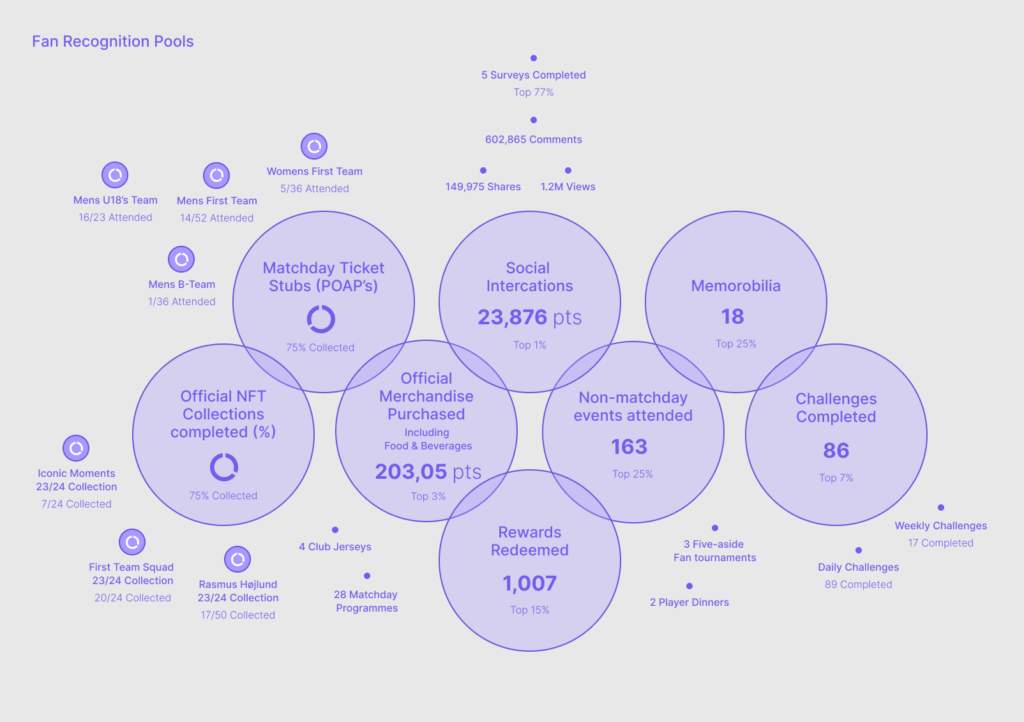
Fan Recognition Model (Concept)
9. Conclusion & The Infinite Game
In conclusion I believe the Future of Loyalty Schemes lies in playing the ‘Infinite game’ rather than’ Finite game. The ‘Infinite game’ was a term coined by Simon Sinek and he defines it in the following way:
In infinite games, like business or politics or life itself, the players come and go, the rules are changeable, and there is no defined endpoint.
Simon Sinek
The products and propositions being offered by a club should be continually changing to adapt to the needs and desires of it’s fanbase.The Roadmap of the club should not be linear and fixed but should be an ever evolving organism which carries vision. Sinek proposes in his definition that we should become less focused upon competition (beating the competition, reacting to the competitions movements etc.) but instead be focused upon macro questions such as:
- How can we integrate the fan more into the Club?
- How can we foster Club Community?
- How can we build direct relationships with our fans?
- How can fans own or contribute to the clubs legacy?
This is truly an exciting and pioneering time for clubs and fans alike and I’m excited to play a role in building within this space. Thanks for reading.
